

7 SEO Strategies for FinTech in 2026
The fintech market is projected to hit $460.76 billion by the end of 2026. More money in the space means more players, and more players means your content is competing harder than ever just to show up.
Here’s what makes 2026 different: Google’s AI Overviews now answer questions directly on the search page. Users get what they need without clicking a single link. For fintech brands, that’s a real problem because you’re no longer just competing for rankings. You’re competing to be the source AI trusts enough to cite.
That bar is higher. It requires actual authority, not keyword-stuffed pages.
This blog post covers 7 SEO strategies for that shift: how to stay visible, keep driving traffic, and hold your ground as zero-click searches become the norm.
7 SEO Strategies for FinTech in 2026
Discover how to lead the search results in a world of AI and shifting user habits. These six methods focus on data, trust, and technical skill.
1. Optimizing for LLM and AI Search Engines
Search has shifted. ChatGPT, Claude, and Google Gemini now answer questions directly without sending users to your site. For fintech, this creates a specific problem: financial topics require verified facts. If your content is vague or generic, these models won’t cite it.
The goal isn’t just to rank on Google anymore. You need your content structured in a way that a machine can read, extract, and reference it confidently.
How to do it:
- AI-Ready Summaries: Open every long guide with a two-sentence summary of what the page covers. It gives search engines something clean to pull.
- Schema Markup: Use JSON-LD to label your pages. For fintech, FinancialService or InvestmentOrAccount schema tells search engines exactly what you offer.
- Factual Density: Don’t restate what every other site already says. Add a specific data point, a real number, or a step that others skipped. That’s what gets cited.
2. Building Content for B2B Decision Makers
B2B fintech buyers aren’t casual readers. They’re CFOs and CTOs searching for a specific fix to a specific problem, whether that’s tool sprawl, compliance gaps, or integration costs. They don’t need an explainer on what fintech is. They need to know if your product solves their problem.
Your content should reflect that. Speak to the role, not just the industry.
How to do it:
- Bottom-of-Funnel Keywords: Target terms like “AP automation for Series B startups” or “embedded finance API pricing.” These people are close to a decision.
- Comparison Tables: Decision-makers want to compare options quickly. Show clearly how your service stacks up against alternatives.
- Lead with Compliance: SOC2, ISO certifications, security protocols — put these front and center. Every B2B fintech buyer will look for them.
3. Information Gain and Original FinTech Data
Google rewards content that adds something new. If your article covers the same ground as the top ten results, it won’t outrank them. You need a reason to exist on that page.
How to do it:
- Annual Trend Reports: Pull anonymized data on how your users spend, save, or invest. Publish the findings. Journalists and researchers will link to it.
- Case Studies: Take a real client problem, show the numbers before and after, and explain what changed. Specifics matter more than summaries.
- Calculator Tools: A savings goal calculator or mortgage interest tool generates a unique result for every user. That’s content no other site can copy.
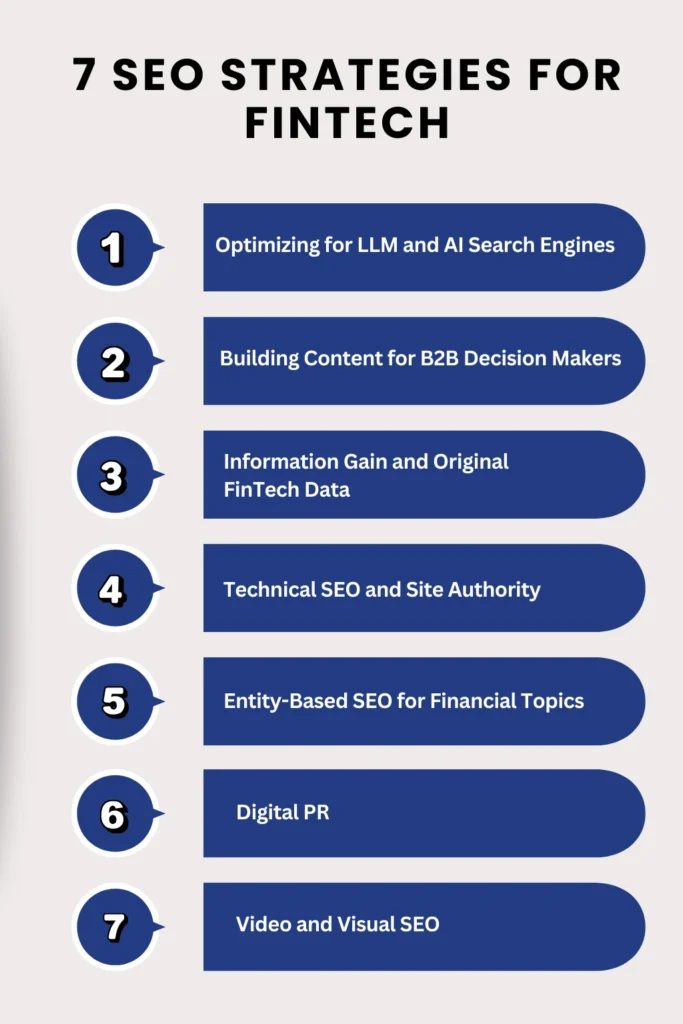
4. Technical SEO and Site Authority
A strong content strategy falls apart on a poorly structured site. Search engines use your site architecture to understand how deep your expertise goes. If your pages are scattered and disconnected, you look like a generalist, not an authority.
Organize around Topic Clusters. If you offer loans, every loan-related article should connect back to one central page. That structure signals coverage, not just keywords.
Technical checklist for 2026:
- Core Web Vitals: Pages should load in under 2.5 seconds. Slow sites lose rankings and users.
- Flat Architecture: No page should be more than three clicks from the homepage.
- Entity Linking: Link your authors and experts to their LinkedIn or professional profiles. It confirms they’re real people with real credentials.
Read our insightful blog on How to Choose an SEO Agency for Fintech?
5. Entity-Based SEO for Financial Topics
Google doesn’t just read words anymore. It recognizes your brand, your team, and your products as distinct entities and connects them in its Knowledge Graph. For fintech, where trust is everything, this matters a lot.
When Google understands that your brand is a legitimate player in payments or lending, it gives your content more weight, especially on topics that affect people’s money or health.
How to build your entity:
- Claim Your Knowledge Panel: Use Google Business and Wikidata to verify your brand’s basic facts.
- Consistent NAP: Your name, address, and phone number should be identical across every platform and directory.
- Co-occurrence: Get your brand mentioned alongside other credible finance names. That association builds trust with search engines over time.
6. Digital PR
Links still matter, but brand mentions may matter more now. When major finance publications reference your company, it builds the kind of signal that influences how search engines and AI models perceive your authority.
A press release won’t cut it. You need stories people actually want to cover.
How to do it:
- Expert Commentary: Get your CEO or founders quoted in finance news outlets on relevant topics.
- Newsjacking: When a regulation changes or a market event breaks, publish a clear explainer fast. Being first earns links.
- Podcast Appearances: Guest spots on finance podcasts build your brand’s presence and strengthen the author entity tied to your domain.
7. Video and Visual SEO
Complex fintech products are hard to explain in text alone. Short-form video helps, and Google now surfaces video clips directly in search results. A 45-second walkthrough of your dashboard could rank above a full written article.
How to do it:
- Add Transcripts: Search engines read transcripts to understand what’s in your video. Always include them.
- Descriptive Alt-Text: Label your charts and graphs clearly so search engines can index the data inside them.
- Short FAQ Videos: Record 30 to 60 second answers to your most common questions. Simple, direct, and easy to index.
Your Path to the Top of the 2026 SERP
The tactics that worked three years ago, stuffed keywords, thin content, generic guides, don’t hold up anymore. Search engines have gotten better at spotting them.
What works now is simpler to say and harder to do: be the most reliable source on your topic. Not just for Google, but for the AI models that are increasingly deciding what users see first.
That means using the data you already have. Your transaction trends, your user behavior, your client results. No competitor can replicate that. When you publish something only you could have written, you stop chasing citations and start earning them.
SEO in 2026 is not a separate workstream. It’s the output of actually knowing your space better than anyone else, and being willing to prove it in public.
Looking for FinTech SEO Services that Actually Deliver? Talk to our experts. We help startups and SMEs grow with data-driven, revenue-focused SEO strategies.