
How Can AI SEO Drive Faster Medical Device Growth?
Your rankings haven’t moved. Your clicks are falling anyway.
That’s not a penalty. It’s not a tougher competitor. Search itself changed under you. Nearly 65% of Google searches now end without a click, and in healthcare, it’s worse.
The AI answers the buyer before they ever reach your site. A hospital procurement officer comparing infusion pumps, a DME supplier evaluating ventilator options, and a cardiologist checking device indications get a synthesized answer inside ChatGPT or Google AI Overviews long before a vendor page enters the picture.
So the game shifts. AI Medical Device SEO isn’t about winning the click anymore. It’s about being the source the AI quotes. If Google AI Overviews, ChatGPT, and Perplexity don’t trust you enough to cite you, you’re invisible during the exact moment buyers are deciding.
Here’s how to fix that.
Why Is Healthcare SEO Becoming More Important for Medical Device Brands?
Healthcare SEO is no longer limited to rankings. Medical device brands must appear in AI-generated answers to stay visible during the buyer’s research journey.
How Search Behavior Is Changing
Buyers don’t type keywords. They ask full questions, and the AI answers before they click.
They expect a direct answer, not a list of links. Search feels like a conversation now, a procurement lead asks “which portable oxygen concentrator is approved for air travel and covered under Medicare?” rather than searching “portable oxygen concentrator.” AI Overviews show up on more healthcare queries every month, and the research often starts inside an AI tool, not Google.
Why Visibility Extends Beyond Rankings
A #1 ranking guarantees nothing. Visibility now lives inside the answer. That’s the core shift behind AI Medical Device SEO.
• AI summaries absorb the explainer traffic: when the Overview defines “enteral vs. parenteral nutrition delivery” in full, your educational page never gets the visit it used to
• Brand mentions shape the shortlist: being named alongside category leaders (ResMed, Philips, Medtronic) in an AI answer puts you on the consideration list before a demo is ever requested
• Citations pre-qualify you: a clinician who sees you referenced next to peer-reviewed data and a clearance record arrives already trusting the brand
• The buying committee narrows options off-site: spec comparisons and reimbursement checks happen across AI tools, and you’re either in that synthesis or you’re not
What AI-Driven Discovery Means for Device Marketing
Clinicians, procurement teams, and distributors, they all research through AI first. A biomedical engineer vetting interoperability, a GPO contract manager checking compliance, and a home-health distributor sizing inventory: each one starts with a conversational query.
AI shapes the earliest stage of research, and authority signals (clinical citations, regulatory clearances, recognized quality standards) tell the model you’re a reliable source. Structured data tells AI what you are, a medical device entity with a specific indication, not just a product page, so the model can place you correctly. Visibility now needs both rankings and AI recognition.
How Is Patient Search Behavior Changing the Way Medical Devices Are Found?
Patients and healthcare professionals now use AI tools throughout the research process. Medical device discovery happens earlier and across more digital touchpoints than ever before.
Buyers stopped searching for keywords. They search in questions, and AI reads the intent behind every one.
How Research Happens Today
• One AI chat takes them from symptom to treatment to device: “my mother has limited mobility” → “manual or power wheelchair” → “which power chairs fit through a 28-inch doorway and qualify for Medicare,” all in a single thread
• AI reads intent, not exact-match keywords: it understands “monitor for irregular heartbeat at home” maps to consumer ECG and Holter-style devices
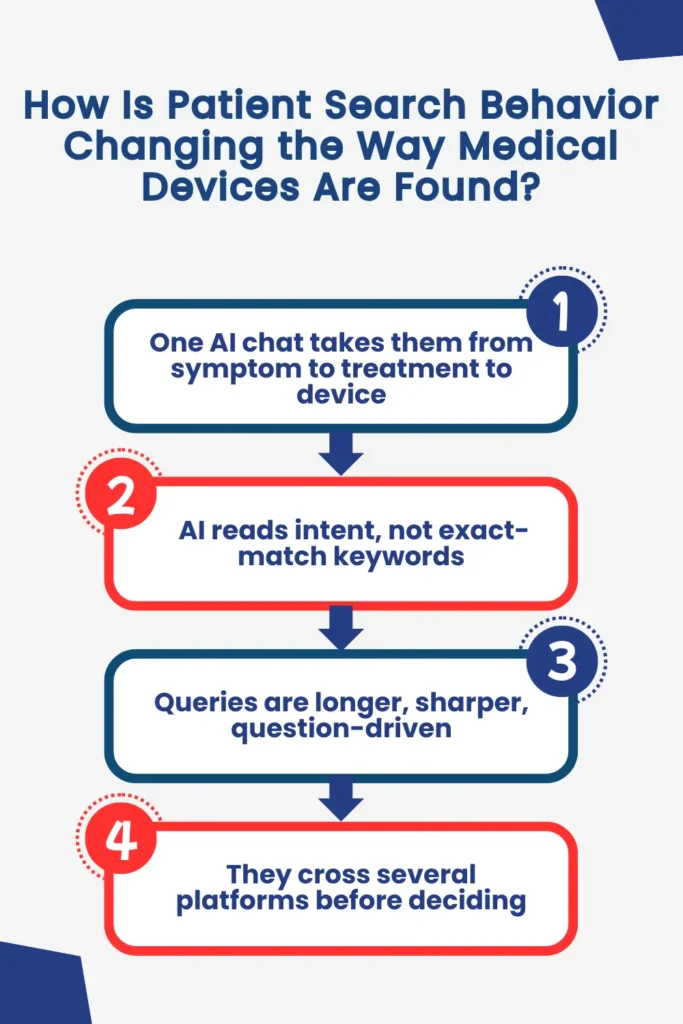
• Queries are longer, sharper, question-driven: buyers specify use case, setting (home vs. hospital), reimbursement, and compatibility in one ask
• They cross several platforms before deciding: ChatGPT for orientation, Perplexity for sourced comparisons, Google AI Overviews for quick checks, then your site for proof
What This Means for Medical Device Marketers
Build content for every stage, not just the bottom of the funnel, awareness-stage condition explainers, mid-funnel device comparisons (e.g., DME vs. HME options), and decision-stage spec sheets. Answer real questions, specs alone won’t cut it; address reimbursement, setup, training, and service. Show up early, not just at the buy decision. Lead with trust, relevance, and authority, and make every fact easy for AI to lift and cite.
Also check Top 7 Reasons Healthcare Companies Struggle with SEO
Why Does AI Healthcare SEO Require a Different Content Approach?
AI healthcare SEO prioritizes clarity, topical depth, and expertise over keyword repetition. Content must provide direct answers and trustworthy information to earn citations in AI-generated results.
Forget what worked for old Google. AI grades content differently; it wants clarity, depth, and proof. That’s why AI Medical Device SEO rewards substance over keyword stuffing.
How AI Interprets Content
Google sees your brand as an entity now, not a bag of keywords; it links your device to its indication, its manufacturer, its regulatory status, and the conditions it treats. AI pulls facts it can quote with confidence (a specific accuracy range, a clearance number, a contraindication), and clear writing is easy to summarize and cite. Thin, generic content, “our innovative solution improves outcomes,” gets skipped entirely.
What Makes Content AI-Discoverable
• Answer the question first. Then explain. Open with the direct answer (“Yes, this nebulizer is covered under Medicare Part B when prescribed for COPD”), then add the supporting detail
• Use clean headings and a logical flow: question-style H2s mirror how buyers actually ask
• Cover the topic fully, not partially: indications, contraindications, setup, reimbursement, and servicing in one authoritative resource
• Add the related context. AI needs to connect the dots: link device to condition, payer policy, and comparable alternatives
• Prove expertise with specifics, not adjectives: cite the clearance record, the clinical study, the recognized standard, not “best-in-class.”
How Can Healthcare Content Marketing Improve Medical Device Visibility in 2026?
Healthcare content marketing improves medical device visibility by answering buyer questions with accurate, trustworthy information. High-quality content helps brands earn AI citations and build authority across search platforms.
Content is how you get discovered now. Buyers read several pieces before they ever contact a vendor. Strong content is the engine of AI Medical Device SEO.
Create Content Around Real Questions
• Build pillar pages for each device category (DME, HME, digital therapeutics, surgical instruments, diagnostic imaging, remote patient monitoring, implantables) so AI maps your brand to the full category
• Add supporting content for specific use cases: “surgical staplers for open vs. laparoscopic procedures,” “infusion pumps for ambulatory vs. inpatient settings,” “pressure-relief mattresses for stage III and IV ulcers.”
• Answer the questions buyers actually ask: reimbursement codes (HCPCS), warranty terms, training requirements, integration with EHR systems
• Drop the sales pitch; lead with clarity : a clinician comparing devices wants specs and evidence, not slogans
Support Every Stage of the Buyer Journey
Awareness: condition and treatment basics (“what causes pressure ulcers,” “how does remote cardiac monitoring work?”).
Consideration: evidence, comparisons, outcomes, head-to-head device specs, clinical study summaries, total cost of ownership.
Decision: implementation, support, specs, setup guides, reimbursement documentation, service-level commitments, and onboarding.
Build Trust Through Valuable Information
• Cite credible studies and real data: peer-reviewed trials, registry outcomes, and post-market surveillance, not marketing claims
• Back claims with clinical evidence: link efficacy statements to the specific study, sample size, and endpoint
• Keep it accurate and current: update for new clearances, recalls, and revised payer policies
• Help readers decide, don’t just sell: honest comparisons (where a competitor fits better) build the trust AI rewards
• Give value before you mention the product: solve the clinical or operational problem first
Why Is E-E-A-T for Healthcare Websites Essential in AI Search?
E-E-A-T plays a critical role in healthcare SEO because medical content falls under Google’s YMYL standards. Strong trust and expertise signals improve both search visibility and AI citation opportunities.
Health content is YMYL. Google holds it to the strictest standard there is. No trust, no visibility. E-E-A-T is the backbone of any serious AI Medical Device SEO strategy.
How Expertise Impacts Visibility
Get content reviewed by qualified professionals, a clinician, biomedical engineer, or regulatory specialist depending on the topic. Show author credentials (MD, RN, RAC, PhD) and hold an editorial process with documented medical review and review dates. Cut the unsupported claims; an unverified efficacy statement can sink a whole page under YMYL scrutiny.
Why Trust Matters Most
• Trust is the foundation of E-E-A-T: Google has stated it’s the most important component; for devices, that means verifiable regulatory and clinical proof
• AI favors verifiable information: a citable FDA 510(k) clearance or CE mark beats any adjective
• Authoritative references get quoted: content grounded in FDA, NIH, and peer-reviewed journals is far more likely to be pulled into an answer
• Accuracy moves your visibility directly: in YMYL, factual errors don’t just lose trust, they suppress rankings
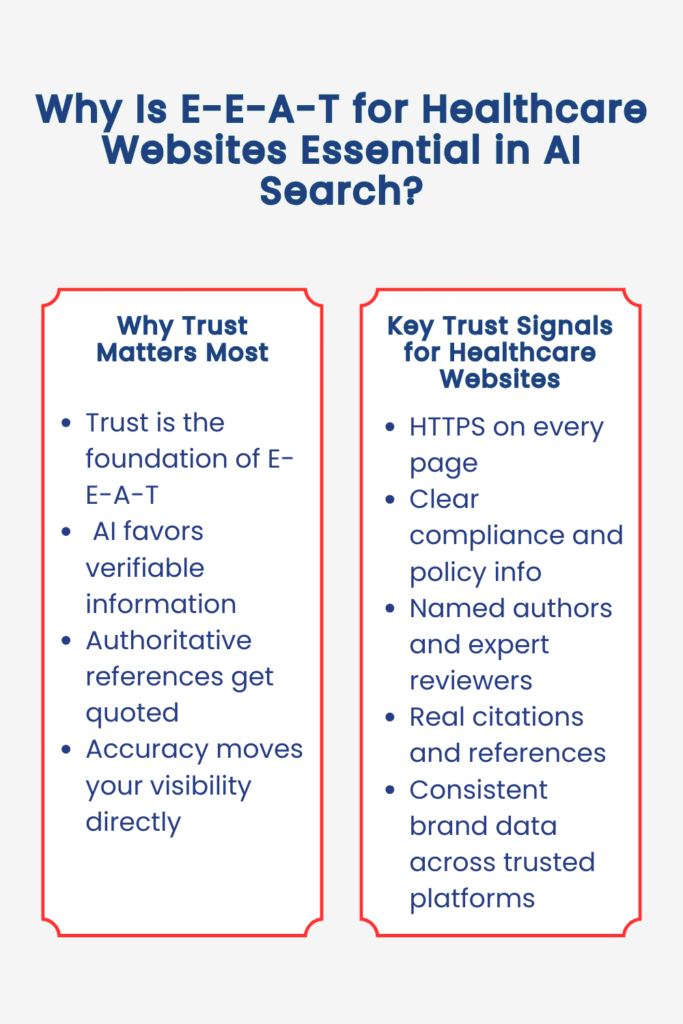
Key Trust Signals for Healthcare Websites
• HTTPS on every page: non-negotiable baseline security
• Clear compliance and policy info: HIPAA statements, privacy policy, and regulatory disclosures where relevant
• Named authors and expert reviewers: with credentials and bios, not “admin”
• Real citations and references: linked to primary sources (FDA databases, clinical journals)
• Consistent brand data across trusted platforms: matching NAP, manufacturer details, and device identifiers (UDI) everywhere you appear
How Can Healthcare Schema Markup Strengthen Medical Device SEO?
Healthcare schema markup helps search engines and AI systems understand medical content more accurately. Structured data improves visibility, supports AI citations, and strengthens E-E-A-T signals.
Schema is how you talk to the machine. It tells search engines exactly what your content means, and it’s a technical pillar of AI Medical Device SEO.
How Schema Improves Content Understanding
Schema defines medical entities and their relationships, deploying Medical Device, Medical Entity, Medical Condition, Medical Procedure, and Organization types so the model knows your infusion pump treats which condition, in which setting, under which clearance. It helps engines read your page accurately, reinforces expertise and topical relevance (linking device to indication and manufacturer), and sharpens content categorization.
Why Schema Matters for Visibility
• Most top-ranking pages already use it: the majority of page-one medical results carry structured data; pages without it are at a disadvantage
• Rich results pull higher engagement : FAQ, HowTo, and product rich snippets earn markedly higher click-through
• It surfaces you for narrow, intent-rich queries : tagged specs and indications match the precise question a buyer asks
• Engines trust structured data more : machine-readable facts reduce ambiguity for YMYL classification
How Schema Supports AI Search
Answer engines lean on structured data when choosing what to quote, FAQPage and Medical Device markup hand them clean, liftable facts. It also connects device, indication, and evidence into one entity graph the model can reason over. JSON-LD is Google’s preferred format; use it (nested for device-condition-procedure relationships), since well-formed data is easier to interpret and reuse than prose alone.
What Should a Modern Healthcare SEO Strategy Include for AI Search?
A modern healthcare SEO strategy must align with how AI systems evaluate and surface information. Success depends on matching search intent, building authority, and creating content that AI can easily understand.
Keyword targeting alone is dead weight. You need a SEO strategy built for how AI actually works, the foundation of effective AI Medical Device SEO.
Map Content to Search Intent
• Cover informational, commercial, and transactional queries: “how does a ventilator work” (informational), “best portable ventilator for home use” (commercial), “request ventilator quote” (transactional)
• Answer the questions buyers ask at every stage: from condition education to reimbursement to procurement
• Match real needs, not just search volume: a low-volume “HCPCS code for X” query can drive a high-value procurement lead
• Chase intent, not keywords: group queries by what the buyer is trying to accomplish
Build Topic Clusters Around Core Themes
Anchor each topic with a pillar page (e.g., a comprehensive “Remote Patient Monitoring Devices” hub) and surround it with supporting articles, device comparisons, condition guides, reimbursement explainers, and integration how-tos. Connect them with internal links so authority flows to the pillar, and compound your topical authority over time until AI treats you as the category reference.
Improve AI Readability and Authority
• Lead with the answer: answer-first paragraphs are what AI extracts
• Keep sections tight and structured: one idea per section, scannable for both readers and crawlers
• Use clear headings and scannable text: question-style H2s and short, factual sentences
• Earn mentions from trusted sources: clinical publications, industry associations, and reputable directories
• Strengthen entity recognition across the web: consistent device identifiers and brand data feed Google’s Knowledge Graph
Why Is AI Search Optimization Becoming a Core SEO Requirement Now?
AI search optimization has become essential because AI-generated answers increasingly replace traditional search clicks. Brands that earn citations gain visibility where buyers now conduct research.
AI answers are eating the traffic you used to own. Here’s the number that should worry you: healthcare queries hit an 83% zero-click rate when an AI Overview appears, the highest of any sector measured. That stat alone makes AI Medical Device SEO a non-negotiable.
How AI Search Affects Traffic
Even a strong ranking now sits below an Overview that satisfies the query outright, so impressions stay high while clicks erode. The traffic that does arrive is later-stage and fewer in number because the early comparison work was done in the chat. Plan for a smaller but higher-intent stream of visitors, and measure influence, not just sessions.
What Improves AI Visibility
• Give direct answers to the real questions: lead with the fact the buyer needs (coverage, indication, spec)
• Back every claim with credible evidence: clinical data, FDA references, and standards citations
• Structure content so AI can extract it: answer-first paragraphs, tables, and FAQ schema
• Hold accuracy and depth: comprehensive, current, and precise beats broad and vague
• Make claims unambiguous: a single, specific, sourced statement is easier for a model to reuse than hedged prose
How Can Local Healthcare SEO Support Regional Demand?
Local healthcare SEO helps medical device brands connect with healthcare professionals and buyers in specific markets. It strengthens visibility for regional and location-based searches.
Demand is regional. Your visibility should be too, reimbursement rules, distributor networks, and provider preferences all vary by market.
Strengthen Local Discoverability
• Optimize your Google Business Profile: accurate categories, service areas, and product lines for each location or distribution hub
• Keep business details consistent everywhere: matching NAP across directories, GPO listings, and distributor pages
• Create region-specific content where it counts: state Medicaid coverage differences, regional service coverage, local clinical partnerships
• Highlight local partnerships and service areas: named hospital systems, regional distributors, and field-service coverage
Support Regional Search Intent
Target location-based queries (“durable medical equipment supplier near me,” “home ventilator provider in Ohio”) and get found by local providers. Reach hospitals, clinics, distributors, the buyers who source within a defined territory, stay relevant to nearby prospects, and own your regional markets.
When Do Medical Device Companies Need Healthcare SEO Services?
Medical device companies often need healthcare SEO services when visibility declines, AI citations are missing, or internal teams lack specialized expertise.
AI search moves fast. Most internal teams can’t keep up, and that’s fine. AI Medical Device SEO takes specialized, ongoing work, equal parts clinical accuracy, technical schema engineering, and regulatory awareness.
Signs You Need SEO Support
• Rankings hold steady while traffic drops: the classic AI-Overview signature: visibility without clicks
• Competitors show up in AI answers and you don’t: rivals get named in “best [device category]” queries while you’re absent
• Organic visibility keeps sliding: impressions and qualified sessions trending down quarter over quarter
• Leads slow to a trickle: fewer demo requests and procurement inquiries from organic
Where Specialists Add Value
Specialists handle building the strategy, implementing the structured data, and earning AI citations through sourced, expert-reviewed content. They focus on compounding topical authority across device categories and handling the technical heavy lifting, Core Web Vitals, entity optimization, and crawl structure.
See the full range of support in our Healthcare SEO services.
Which Metrics Show Whether Healthcare SEO Strategy Is Working?
Modern healthcare SEO measurement goes beyond rankings. Brands must track visibility, engagement, AI citations, and business outcomes.
Traffic alone lies to you now. Watch the metrics that show real influence.
| Metric Type | Key Performance Indicator (KPI) | What It Measures |
| Visibility | Organic Impressions & Trends | Overall brand footprint across both traditional SERPs and emerging AI search environments. |
| Interaction | Organic Clicks & Engagement | Active traffic generation and depth of user engagement with your technical assets. |
| AI Integration | AI Citation Share of Voice | How frequently is your domain cited as a factual source in AI Overviews and conversational engines? |
| Business Impact | Qualified MQLs & Demo Requests | The volume of high-intent inbound inquiries from hospital procurement officers and clinicians. |
Why Flying Elephant Digital for AI SEO?
Medical device SEO needs a strategy built for AI search, not last year’s playbook. Visibility now runs on authority, trust, and citation potential. That’s exactly what AI Medical Device SEO demands.
That’s what Flying Elephant Digital builds.
What Sets the Approach Apart
• Deep healthcare and medical device SEO expertise: across DME, HME, digital health, and clinical device categories
• AI-focused content strategy: answer-first, evidence-backed content built to be cited
• Advanced schema implementation: nested MedicalDevice, MedicalCondition, and FAQPage JSON-LD
• Strong E-E-A-T foundations: clinician review, credentialed authorship, sourced claims
• Entity-based optimization: connecting your brand and devices into the Knowledge Graph
What Clients Gain
Clients get named in the answers their buyers actually read on the shortlist before a sales conversation begins. Authority compounds, organic performance steadies against the zero-click drag, and the traffic that arrives skews toward decision-ready procurement officers and clinicians, the people who sign off on the purchase.
How Medical Device Brands Stay Visible in AI Search
Search is rewriting itself. Your healthcare SEO has to keep pace or disappear from the research that decides every deal. The brands that win at AI Medical Device SEO will be the ones search trusts most.
It comes down to three things: build authority, earn trust, and make your content effortless for AI to understand. Everything above is a way of doing one of those three.
Where to Start This Quarter
Pick your highest-value device category and build one true pillar page around it, reviewed by a credentialed expert and marked up with the right schema. Then watch a metric you probably aren’t tracking yet: how often you’re named in AI answers for that category. That single workflow, build, verify, structure, measure, is the loop you’ll repeat across the rest of your catalog.
Win trust from both people and machines, and you stay visible no matter how search shifts next.
Deep-Dive FAQs: AI Medical Device SEO
1. How can we track conversions if AI Overviews cause zero-click searches?
Pivot from tracking web sessions to monitoring brand entity mentions and citation share of voice in AI engines. Because AI-driven discovery often registers as “Direct” traffic when users finally visit, update your CRM lead forms with a “How did you hear about us?” dropdown featuring options like ChatGPT, Perplexity, and Google AI.
2. How does the YMYL policy differ for B2B vs. patient-facing device sites?
Google applies Your Money or Your Life (YMYL) standards strictly to both, but evaluates them differently. Patient sites require accessible language and clear risk disclosures. B2B sites require technical rigor, including granular engineering specs, peer-reviewed clinical data, FDA clearance details, and ISO 13485 compliance, to satisfy informational safety requirements.
3. Will updating legacy content for AI readability hurt traditional rankings?
No. Formatting content with direct, answer-first paragraphs, clear tables, and logical heading hierarchies perfectly aligns with Google’s Helpful Content guidelines. Making your text easy for an LLM to parse simultaneously makes it easier for traditional search crawlers to rank your site and award rich snippets.
4. Can generative AI fully replace human writers for a medical device blog?
No. Relying entirely on raw generative AI introduces compliance risks, medical inaccuracies (hallucinations), and generic copy that fails E-E-A-T criteria. While AI can assist with structural outlines and keyword clustering, the final content must be authored or heavily refined by medical subject matter experts and pass clinical review to meet strict FDA marketing standards.